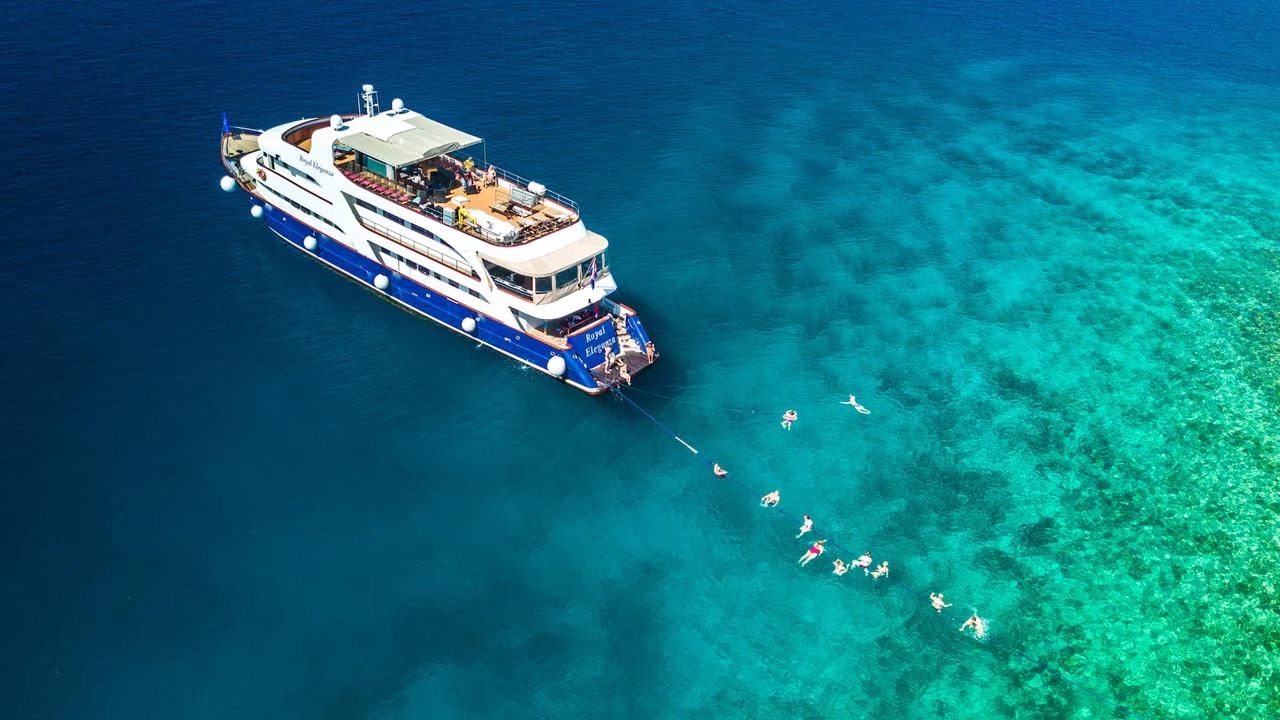
Say the word “cruise” to most people and they picture the same thing: a floating hotel, a buffet the length of a football field, a pool deck, and a schedule built around sea days between one big port and the next. An adventure cruise shares almost none of that DNA, and the confusion between the two is probably why so many travellers rule out cruising altogether without realising there’s a genuine adventure cruise built around small ships and real activity aimed squarely at people who’d never book the first kind.
Searches for adventure cruises Australia have climbed steadily for a reason — there’s real demand from travellers who want the logistics of a cruise (one booking, no driving, meals sorted) without the trade-off of spending a week doing very little. The result is a smaller, more active style of cruising that’s grown steadily in this country over the past couple of decades, particularly in parts of the coast that a conventional itinerary could never reach anyway.
The Core Difference: What You Do, Not Just Where You Go
The clearest way to separate an adventure cruise from anything else wearing the same name is to ask what happens once the ship stops moving.
On a conventional cruise, stopping means docking at a port with shops, restaurants and an organised shore excursion you book through the ship. On an adventure cruise, stopping usually means anchoring somewhere with no port at all — a bay, a river mouth, an uninhabited stretch of coast — and then getting off the main vessel into smaller tenders, kayaks or inflatables to actually explore it.
That difference shows up everywhere in how the day is structured:
- Multiple landings a day rather than one scheduled port call
- Activity-led itineraries — snorkelling, hiking, fishing, wildlife spotting, sometimes diving — built into the schedule rather than offered as a paid add-on
- Small guest numbers, often somewhere between twenty and a couple of hundred rather than several thousand
- Expert guiding, usually from crew with genuine specialist knowledge of the region rather than generalist cruise-ship staff
None of this makes an adventure cruise “better” in some universal sense — a seven-night Mediterranean cruise with theatre shows and a casino is exactly what a lot of people want from a holiday, and there’s nothing wrong with that. It’s simply a different product built for a different kind of traveller, and conflating the two leads to disappointed expectations on both sides.
Why Australia in Particular Suits This Style of Travel
Australia’s coastline is uniquely suited to adventure cruising, and it’s not really a marketing angle — it’s geography. Enormous stretches of the northern and western coast have no road access whatsoever, which means a conventional land-based holiday simply can’t reach them, and that scarcity is exactly what has driven demand for adventure cruises australia over the past decade. An operator running this kind of expedition-style itinerary isn’t offering a stylistic choice so much as the only practical way to see some of the country’s most striking natural features.
The Kimberley region is the standout example. Tidal ranges of ten metres or more create phenomena found almost nowhere else on Earth — Horizontal Falls, where the tide forces water through narrow gaps in a coastal range fast enough to look like a genuine waterfall running sideways, and Montgomery Reef, which appears to rise directly out of the ocean as the tide drops. Neither is accessible by road. Both are built for exactly this style of cruising, and neither would mean much seen from the deck of a large ship that couldn’t get within kilometres of them.
Beyond the Kimberley, Australia’s broader coastline and its near neighbours — Papua New Guinea, parts of Indonesia, the Coral Sea — offer the same pattern: remarkable, remote, and genuinely difficult to reach any other way.
What to Actually Look For Before Booking
Because “adventure cruise” isn’t a protected or standardised term, the quality bar between operators varies enormously. A handful of practical checks go a long way toward separating a genuine expedition experience from a conventional cruise with a marketing refresh.
Start with guest numbers. A ship carrying a few dozen guests behaves completely differently to one carrying a few thousand — smaller numbers mean the vessel can anchor in tighter spaces, land more people ashore at once relative to the group size, and adapt the day’s plan around weather or wildlife rather than a fixed schedule locked in months in advance.
Then look at what’s actually included. Genuine adventure operators typically bundle activities — kayaking, fishing, guided walks, sometimes even a helicopter for aerial access to places a boat can’t reach at all — into the base fare, because those activities are the point of the trip rather than an upsell. If every interesting thing on the itinerary carries an extra charge, that’s worth factoring into the real cost of the holiday.
Finally, check the crew-to-guest ratio and the specific expertise on board. A marine biologist, a qualified dive instructor or a guide with genuine regional knowledge changes the quality of every landing enormously compared with a generalist activities coordinator reading from a script.
How an Adventure Cruise Itinerary Actually Gets Built
Understanding how these itineraries are put together explains a lot about why they feel so different from a conventional cruise schedule once you’re actually on board.
A conventional cruise itinerary is fixed months, sometimes years, in advance, and locked into published port schedules that rarely change regardless of conditions on any given day. Adventure cruise itineraries, by contrast, are usually built around a rough route and a firm departure and return date, with the specific daily plan finalised only once the ship is underway and the crew can see what the tide, weather and wildlife are actually doing.
That flexibility is deliberate rather than a sign of poor planning. If conditions favour an early-morning landing at one site over an afternoon one, or if a pod of whales is spotted moving through a particular channel, a genuinely expedition-minded crew will adjust the day to make the most of it rather than sticking to a printed schedule for its own sake. This is one of the clearest practical differences between an adventure cruise and a conventional one: the itinerary serves the experience, not the other way around.
It does mean guests need to hold a specific date loosely rather than expecting a guaranteed hour-by-hour plan before departure — most operators are upfront about this, publishing a general route and day count rather than a rigid schedule, precisely because rigidity is the wrong tool for genuinely remote, tide-dependent country.
Physical Demands and Who This Style of Travel Actually Suits
It’s worth being straightforward about this rather than glossing over it: adventure cruising asks more of guests physically than a conventional cruise does, though considerably less than most people assume before trying it.
Getting from ship to shore usually means stepping into a tender or inflatable, sometimes over a bit of a swell. Landings can involve a beach walk over uneven ground, a scramble up a rocky point for a lookout, or a walk to a waterfall along a bush track. None of it requires serious fitness, and well-run operators are experienced at accommodating a wide range of ages and mobility levels — but it’s genuinely different from wheeling a suitcase down a gangway onto a paved dock, and worth knowing in advance.
What that buys in return is access most travellers never get. Standing at the base of a waterfall nobody drove to, watching a saltwater crocodile from a tender at close range with someone who actually understands its behaviour, or landing on a beach with no other footprints on it — these are the moments that adventure cruising is actually selling, and they’re largely unavailable to a conventional itinerary regardless of budget.
What Adventure Cruises Actually Cost, and Why
Price is usually the first question people ask once they understand what an adventure cruise involves, and it deserves a straight answer rather than a vague one.
Per-day rates on genuine expedition-style adventure cruises typically sit above what a mainstream cruise line charges, and the gap isn’t arbitrary. Small vessels spread their operating costs across a far smaller number of guests, remote provisioning and fuel logistics cost more than servicing an established port route, and specialist guiding staff — the marine biologists, dive instructors and regional experts that make the activity-led itinerary work — cost more to employ than generalist cruise staff.
In exchange, most of what would be an optional extra on a conventional cruise tends to be bundled into the base fare on a proper adventure itinerary: kayaking, snorkelling gear, guided walks, sometimes even a helicopter flight to a location the ship itself can’t reach. Add those inclusions up against the equivalent à la carte cost on a mainstream ship, and the actual gap between the two options often narrows considerably once genuine like-for-like activity is factored in rather than just comparing headline nightly rates.
The more useful comparison, then, isn’t nightly price in isolation — it’s price against what’s genuinely included, how many guests share the vessel, and how many of the days involve real activity ashore rather than time spent purely on board.
Booking Through an Agent Versus Booking Direct
One practical question that comes up constantly once someone’s decided an adventure cruise is the right fit: is it better to book through a travel agent or go directly to the operator?
There’s no universally correct answer, but a few patterns are worth knowing. A good specialist agent — particularly one who’s actually sailed with the operators they recommend — can be genuinely useful for comparing across several small operators at once, since the adventure cruise market is fragmented enough that doing that research independently takes real time. Agents can also flag departure dates likely to sell out, cabin categories worth the upgrade, and occasionally access fares or perks not advertised publicly.
Booking directly tends to suit travellers who already know exactly which operator and itinerary they want, since it cuts out an intermediary step without necessarily changing the price — most reputable operators don’t undercut their own agent network, so direct booking is rarely cheaper, just simpler for someone who’s already decided.
Either way, the questions worth asking before committing are the same: what exactly is included in the fare, what’s the cancellation and refund policy given how weather-dependent these itineraries genuinely are, and what happens if a specific activity or landing has to be skipped due to conditions on the day.
The Honest Trade-Off
Every style of travel involves a trade-off, and adventure cruising is no exception. It generally costs more per day than a mainstream cruise line, carries fewer entertainment options on board, and demands a bit more physical willingness from guests. What it buys back is remoteness, genuine wildlife encounters, expert guiding, and access to places that simply aren’t part of any other holiday format.
For travellers who’ve done the standard cruise once and found it a little too passive, or who’ve always wanted to see Australia’s wildest coastline but assumed it meant weeks of 4WD driving and camping, adventure cruising sits in a useful middle ground — most of the comfort of a cruise, most of the access of an expedition, and very little of the compromise either extreme usually demands.
